Tuesday, November 10, 2009

My Last Meal and Shoti

I love to watch Anthony Bourdain: No Reservations. Bourdain’s cynical attitude is so infectious and entertaining. Every now and then, he’ll ask someone on the show what their last meal would be if they were going to die the next day. I ponder the question myself every time I hear him bring it up. One would think that I’d simply choose whatever is my favorite food is, but different foods can evoke different emotions and memories. My favorite food (the jury is still out on this one) may not carry the sentimental significance as other foods.

jookpate chaud

cha giodosa   

The things that would typically come to mind are pho, bot chien, cha gio, murgh makhani, dosa, my grandma’s Thanksgiving turkey, my mom’s “Rice, Butter, Maggi, Egg” (exactly what it sounds like, the egg cooked sunny-side up), jook/congee/chao with fried donut and 1000 year old egg, my grandma’s vegetarian pate chaud, moussaka, unagidon, hummus, and baba ghanoush. (pictures via http://www.mightysweet.com/mesohungry and  http://www.flickr.com/photos/goincase/)


Then I heard David Chang’s response to Bourdain when he was asked “what’s food porn for you?”  Chang’s response was “bread and butter is probably my favorite thing.”  That’s when it hit me.  Bread and butter.  Nothing more. Nothing less.  That’s what I want my last meal on Earth to be.  Whether or not the butter is salted or not is still up for debate, though.

Thursday, November 5, 2009

Pho

IMG_4191

Pho, while not necessarily my absolute favorite thing to eat, is without a doubt one of my comfort foods.  Everything about it invokes some kind of memory and puts me at ease.  I don’t recall my mom cooking pho too often when I was young, and when she did it seemed like it was usually pho ga which is chicken-based rather than beef-based.  Even so, going out for pho wasn’t uncommon.
The thing about pho is that it’s so personal.  From the cuts of meat that you like in it, to whether or not you put hoisin sauce and sriracha directly into the soup, to whether or not you add bean sprouts or lime, to how you eat it, the list goes on and on and every choice is a personal one.  My idealized version of pho consists of the following:
  • a super beefy stock that is on the sweet side
  • short rib, oxtail, raw flank steak, tendon, and bible tripe
  • green onion, cilantro, and Thai basil
  • slightly chewy noodles
  • 2/3 hoisin mixed with 1/3 sriracha on the side
IMG_4094IMG_4098 IMG_4083 IMG_4080

For the base of the stock, I like to use a combination of oxtail and marrow bones.  This time, I opted for just oxtail and I like to brown them first so they develop a nice crust for some extra flavor due to the Maillard reaction.  One of the keys to getting a sweet stock is to char the onions and ginger that go into the stock.  I also like to put roasted garlic into my stock for another subtly sweet note.  It was pretty cold outside, so instead of using my grill to char and roast, I used my oven.  An additional sweet component that is traditionally used in pho is yellow rock candy.  Never try to substitute sugar for yellow rock candy.  It just isn’t the same.  A myriad spices including star anise, cinnamon, cloves, fennel seeds, cardamom, and coriander seeds give the stock its distinctly anise-y tone.  Lastly, you can’t call something Vietnamese without a decent amount of fish sauce.

IMG_4079IMG_4110
IMG_4114IMG_4124

As I mentioned earlier, I tried something different this time around: gelatin filtration.  The process took forever, 4 days, because the blocks of stock were pretty thick.  My entire fridge started to smell like pho and I was left with quite a bit of gelatin.  But was it worth it?

IMG_4146IMG_4148
IMG_4160

Above and to the left is the gelatin after all the liquids had melted.  Above and to the right is the resulting liquid.  It turned out crystal clear.  In fact, I could indeed see the date of a dime at the bottom of a bowl.  In the end, I probably won’t bother filtering my stock in the future through gelatin filtration.  It was just too time consuming even though I didn’t have to do anything.  I mean, how’s a person supposed to wait 4 full days to enjoy some pho after cooking it?  Perhaps if I was trying to impress an audience I’d do it, but for me I don’t care if my stock is murky and full of impurities.

IMG_4204

As for how I eat pho, I usually get some noodles, meat, and herbs between my chopsticks and use my spoon to slather on the hoisin/sriracha sauce to what’s hanging off my chopsticks and gorge.  My perfect bite of pho is illustrated above.  Between shoveling noodles and meat into my mouth, I’ll take a sip of broth.  I’m not the biggest gulper of pho broth and like a larger ratio of noodles to broth.  And that’s what pho is to me.

Saturday, October 31, 2009

Halloween, Pho, and Gelatin Filtration

A little late for an acknowledgment of Halloween, but oh well.  (Hot dog via WBEZ)

12923_pe_1210331741Peapod Man46342_pe_121792050320091030_babyhotdog_500x332 

In other news, I made some pho this weekend (well, really just the stock so far) but I’m trying something different.  I usually don’t bother to clarify the stock because I’m too lazy and I don’t mind that my stock is murky as long as it tastes good.  However, while watching an episode of Heston Blumenthal’s In Search of Perfection  I stumbled upon a technique to clarify stocks without the hassle of using a protein raft.  The technique, gelatin filtration, involves freezing the stock and letting it melt very slowly through a strainer.  The details are described here by the always awesome Harold McGee.  I’m really curious as to how clear the stock is going to come out and if I’m going to miss any of the mouthfeel provided by the gelatin that will be removed.  I’ll update with the results of the clarification process and my thoughts on pho too.

Thursday, October 29, 2009

Alinea: 9-06-09, Courses 4-5

LILAC – scallop, shellfish, honeydew

IMG_3893 

I’d never eaten anything with lilac in it, and I really didn’t know what lilac smells like so I wasn’t sure what to expect.  The lilac was integrated into what the server described as “pillows.”  The pillows were made of kudzu and were silky smooth and melted in my mouth.  They’re the white circular things in the picture.  It might have been the fact that my sense of smell was almost shot, but I couldn’t really taste the lilac.  I feel floral notes tend to be very dependent on aroma, so this could explain it.

Despite this, the lilac was the first dish that really made me think “wow.”  Although the main component of the dish was said to be lilac, the broth was pure essence of briny shellfish and was the real star of the dish.  I thought to myself “this is what clam chowder should taste like.”

IMG_3892

A porous bread was served with the dish, which made it an excellent vessel for sopping up broth.  The honeydew foam and tiny balls of honeydew added a nice sweetness to even out the brininess, but I wasn’t completely in love with it.  The server mentioned that Achatz liked pairing shellfish with melon, but I didn’t leave convinced that shellfish and melon was a home run combination.

On to things that I didn’t like.  The scallops were cooked fine, but a couple of the mussels I got were overcooked and a little rubbery which shocked me considering the caliber of the restaurant I was eating at.  Also, there were small slices of raw celery that garnished the top of the dish, and if you know me then you know how much I hate raw celery.  I like to pride myself on how I’m not a picky eater and will eat anything, but more than a few bites of raw celery can make me gag.  I could've done without the celery, but that’s only because of my weird aversion to raw celery.

PIGEONNEAU - á la Saint-Clair

IMG_3894IMG_3895 

I knew something was up when antique stemware was placed on the table.  The server then described that the next dish would be paired with a drink: a house-made cherry balsamic soda.  It’s probably not fair to compare the soda to black cherry flavored Shasta, but it reminded me of it.  Only way more complex.   The balance of sweetness and tartness was perfect.

Then, the squab came out plated on antique dishes from 1903.  The server explained how on nights with lots of Tours (the dish was only available on the Tour) things can get a little crazy because they only have a limited number of antique dishes.  The story is that Achatz went hunting for the perfect antique dish but fell short because the vendor didn’t have enough.  Apparently Achatz turned to eBay and found someone selling antique dishes that met his aesthetic demands and at a decent quantity.

The squab itself was cooked nicely and laid on a bed of foie gras mousseline inside of a pastry.  Two quenelles of foie gras, mushroom, and onion outlined the circumference of the pastry with a super tasty sauce rounding out the dish.  Each individual component of the dish was amazing, but it wasn’t until I was smart enough to take a small slice of each ingredient, slather some sauce on top, and eat everything in one bite did the dish get elevated to a new level.  I suppose I wasn’t used to so many components to a dish being on the plate; this was the first of several times during the night where I was confused as to how I should eat the food.  What wasn’t confusing, however, was how well the cherry balsamic soda went with the squab.  It vividly reminded me of eating turkey with cranberry sauce.

Aside from the amazing taste of the dish, I couldn’t help but grin with glee and chuckle inside.  I took the fact that Achatz did such a classic dish prepared so classically as a retort to all the critics who may label his progressive style of cooking as heartless molecular gastronomy that strays away too far from what cuisine should be.  To me, it was Achatz saying “I’m more than just fancy foams and jiggly gels.”  The contrast of this dish with the rest of the meal was a nice touch.

After 2 incredible and substantial dishes, we would experience what is arguably Achatz’s signature dish: Black Truffle Explosion.

Wednesday, October 28, 2009

Alinea: 9-06-09, Courses 1-3

The day to eat at Alinea finally came and I had one of the worst colds I’ve ever had in recent memory.  I was coughing pretty much nonstop, my body was rundown, my sense of smell was at limited capacity, but there was no way I was backing out.  Plus, I would’ve been charged a hefty cancellation fee.
IMG_3868 IMG_3869

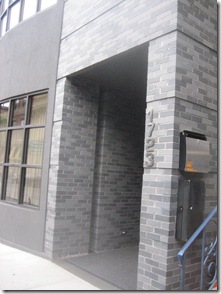
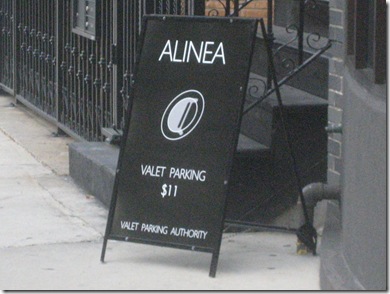
I think it’s fairly well known by now how unassuming Alinea’s facade is on the street, but for the uninitiated, the only signage for Alinea is its valet parking sign.  One could easily walk right by the building and wonder where arguably the finest restaurant in Chicago is located if they miss the sign.  This was just the start of Alinea challenging one’s sense of how things should be.
 319554547_d6efa22f0e

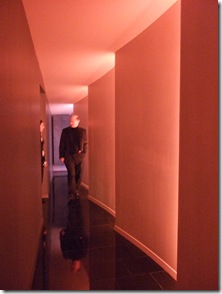
Ah, the infamous hallway.  I had read about it before, so I knew what to expect.  I forgot to take a picture of the hallway (picture via http://www.flickr.com/photos/arhe/), but my mom who lead the way pretty much ended up like the guy in the picture.  The hallway is an optical illusion of sorts, making you believe there is an entrance at the end by gradually funneling you to the end.  However, once you get to the end, you’re taken by surprise by a sliding door behind you to the left and you must make your way back a few steps.

IMG_3873 IMG_3875

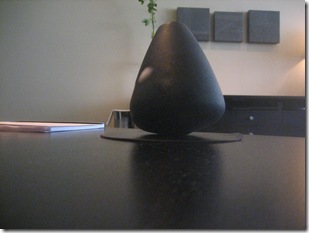
We were greeted by the hostess who led us to our table on the first floor.  At the table, there awaited 3 servers behind each of our chairs to seat us.  I snapped a picture of the linens, which had a Alinea’s namesake on it.  After confirming that we would be having the Tour, typically about 24 courses, and that we had no dietary restrictions, the centerpiece for the night was place at one end of our table.  It looked like a ceramic gourd filled with what was thought to be dry ice due to the condensation and frost that slowly built up on the outside.  The centerpiece comes into play later on in the meal, and I was pretty excited to see what it would eventually be used for.

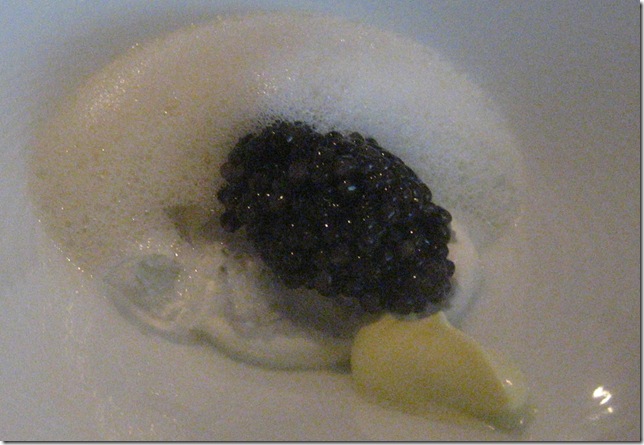
OSETRA – traditional garnishes
Copy of IMG_3879

The first dish out was osetra caviar with “traditional garnishes” prepared in an untraditional way.  The server described how Achatz wished to highlight the mouthfeel of the caviar, and so rather than serving it traditionally with some type of bread or cracker it was served along side a foam brioche.  The foam tasted so much like brioche.  It kind of blew my mind how a foam could taste exactly like bread.  Capers, onions, and dill were distilled and made into a gel to round out the traditional flavors alongside an egg yolk emulsion and crème fraîche.

 PORK BELLY – iceberg, cucumber, thai distillation

IMG_3883IMG_3884

The second dish was a Thai-inspired pork belly dish served with a distillation of Thai chili, lemongrass, and fish sauce.  The distillation was taken like a shot and was meant to set the palette for the types of flavors in the pork belly.  The smell of the distillation was overwhelmingly of Thai chili, with traces of lemongrass and fish sauce.  The distillation tasted like mildly salty water, but not in a bad way as the saltiness subsided almost immediately.  Ultimately, I didn’t think the distillation added anything to the dish other than the initial aroma of Thai chili.

The pork belly was cooked incredibly well and sandwiched between two piece of crispy iceberg lettuce, topped with various herbs, and rested atop a pool of basil seeds.  I’d never had basil seeds in anything but Vietnamese basil seed drink (nuoc hot e, referred to as the “tadpole” drink when I was young), so having it part of the dish was neat and reminded me of my youth.  Another point of familiarity for me was the fact that the pork belly was paired with crispy lettuce.  This is such a common practice in Vietnamese cuisine: I’ve been wrapping cha giò in lettuce since I can remember.

IMG_3882IMG_3881

The pork belly arrived with a bread accompaniment: a cilantro roll.  The two butters served were a butter made in-house topped with black lava salt and another butter from Wisconsin.  The cilantro roll made perfect sense going with the Southeast Asian tone of the pork belly.

OXALIS – juniper, gin, sugar 

IMG_3889

The oxalis came incased in a gel on what is probably best described as a metal guitar tab with a curve at the tip.  At the time of eating, I had no idea what oxalis was, but it gave the bite a fresh bitter greens/floral taste.  Combined with the subtle sweetness of the gel, it served as a nice palette cleanser since Southeast Asian flavors can tend to be very in your face and set things up for the first substantial dish of the night: the lilac dish.